
A good base is the key to a long life for a shipping container: when it stands level, the doors close well, water does not collect underneath and the floor does not rust. This article explains what kind of base a container needs, how to prepare the site and what to know for delivery day.
Why the base matters
The whole weight of a shipping container goes into the ground through its four corner castings. On uneven ground the frame and doors twist: the doors become hard to close and the seals stop keeping water out. Standing directly on soil, the container collects moisture underneath and its floor starts to rust. That is why it pays to lift the container slightly off the ground and set it level.
Bases that work
- Concrete blocks or slabs under the corners. The simplest and most common solution for a storage container. The blocks sit on compacted crushed stone, all at the same height. A 40ft container usually gets an extra support in the middle.
- A gravel bed. A levelled, compacted layer of crushed stone lets water drain away and suits a temporary container. Best combined with concrete blocks under the corners.
- Screw piles. A good choice on soft or sloping ground and for container homes. The piles are screwed into the ground and the container is fixed to them.
- Concrete strips or a slab. A more permanent solution for a container home, office or several containers side by side.
For a container home or other building, also ask your local municipality about foundation requirements and permits.
How to prepare the site
- Pick the spot. It should be at least half a metre larger than the container on every side, with room in front for the doors to open fully.
- Remove turf and topsoil and lay a compacted layer of crushed stone.
- Level the supports. Use a spirit level or laser to check that all support points are at the same height.
- Think about water. Rainwater must drain away from under the container; do not build the base in a hollow.
Delivery: what the crane truck needs
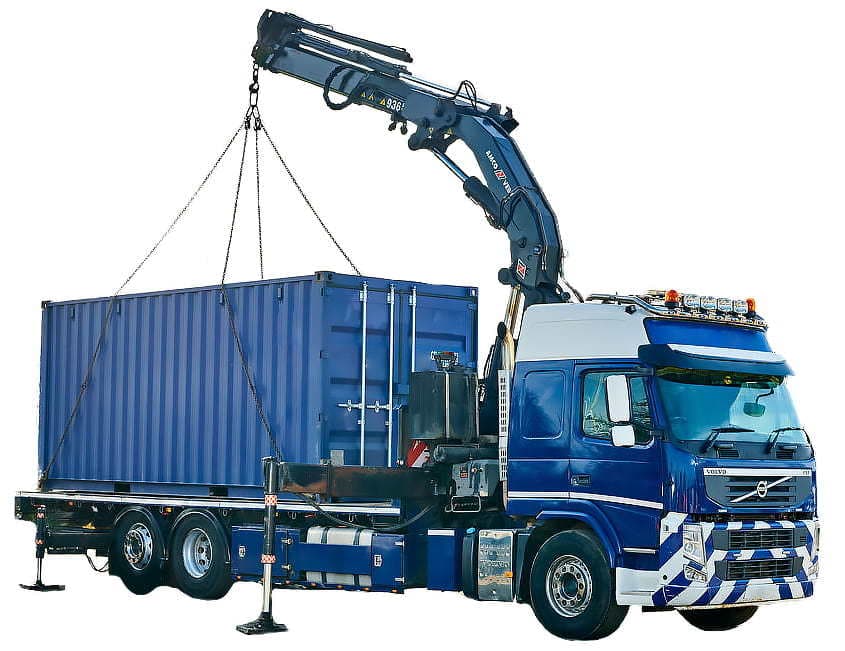
We deliver containers with a crane truck or a side loader, chosen to suit the container size and the site:
| Vehicle | Container | Body length | Lifting capacity | Reach |
|---|---|---|---|---|
| Small crane truck | 10-20 ft | 6-7.5 m | 10-15 t | 9-12 m |
| Large crane truck | 40-45 ft | 12-13.7 m | 17-21 t | 12-14 m |
| Side loader | containers up to 32 t | semi-trailer | up to 32 t | sets the container about 1 m from the truck |
A crane truck can lift a container over a fence or another vehicle if its reach allows. A side loader puts the container down right beside the truck and suits places with no room for a crane. For special types (open top, flat rack, tank, reefer) we also use a telescopic semi-trailer. See transport services.
Checklist before delivery
- Can the truck reach the site? Check the gate width, the road and the turns.
- Can the road take a heavy truck? Soft ground or lawn may sink after rain.
- Are there power lines or branches above the spot that would get in the crane's way?
- Is there firm, level ground for the crane's outriggers?
- Is the base ready and level?
- Will someone be on site to show where the container goes and which way the doors should face?
When you ask for a quote, send the delivery address and, if possible, a couple of photos of the site - then we can choose the right vehicle and give an exact price.
Winter placement
Containers can be delivered and placed in winter too. Frozen ground often carries a heavy truck even better, but snow must be cleared from the site and the access road beforehand, and the supports should be in place before the ground freezes.
In short
A level, firm base, clear access for the crane truck and room in front of the doors - these three things make sure the container serves you for a long time. To pick the size, see shipping container dimensions; containers are on shipping containers for sale. Questions? Call +372 505 46 14 or email sales@cway.ee.